

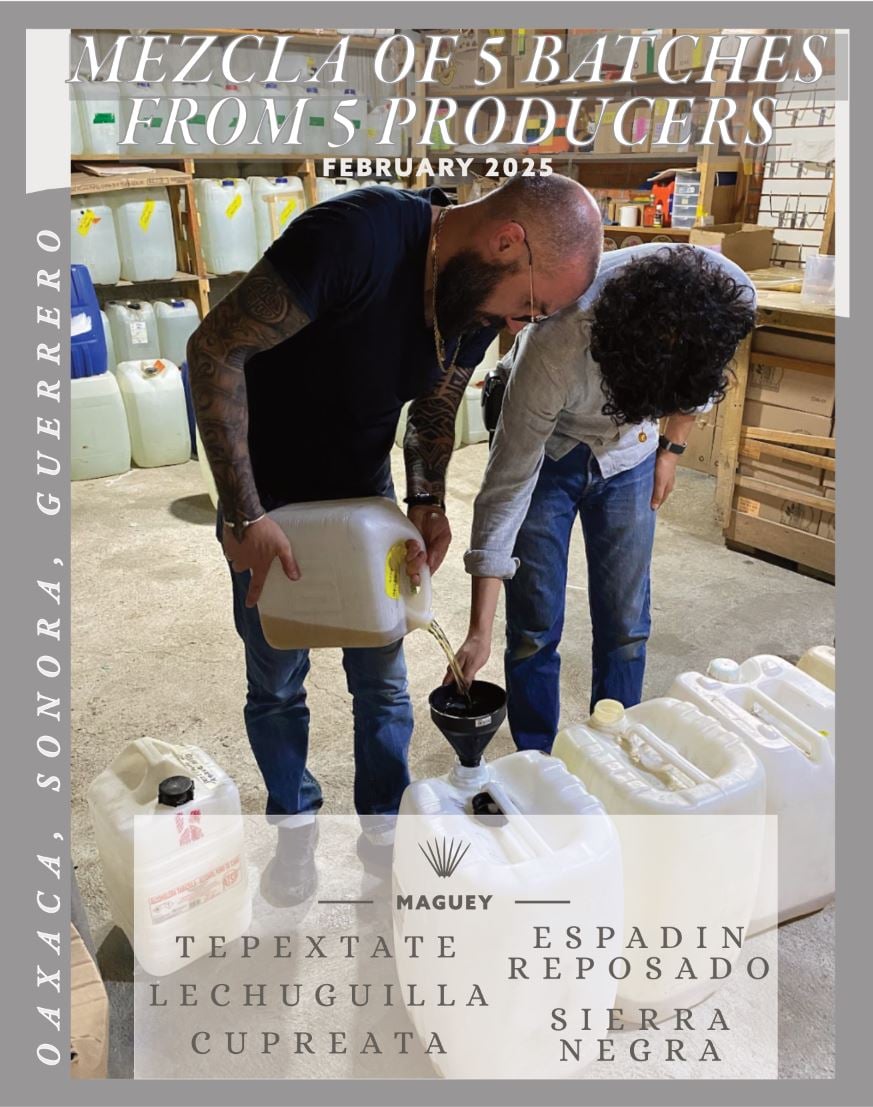
Mezcla of 5 Batches
Our riskiest experiment to date
Hey, it’s me, Chava Peribán.
This brand new 2025 we decided to give master-in-chief Dalton some well-deserved free time. So for the time being, I’ll be writing this newsletter. For those who may not be familiar with me, I have a podcast called Heritage Mezcal in which I explore all things agave and some other Mexican delights.
While at Maguey Melate, I curate many of the expressions that become our monthly features and make all the videos and photos that populate our social media. In my decade-long relationship with Mexican spirits, I’ve sampled hundreds of Mexican spirits, most of them made with agave (aka maguey) or dasylirion (aka sotol or cucharilla), but also plenty of expressions made with sugar cane, fruits (love you mango!) and grains.
This has been a very entertaining endeavor because each place, hand, and raw material comes with novel ways of understanding the infinite flavors created via fermentation and distillation. I reckon this vast diversity could entertain anyone for more than a few lifetimes, but I am still always wondering about the things I haven’t yet found. Flavors that while being rooted in tradition are still a reflection of our times.
A piece of the story
But before going into further details about this batch I would like to offer a bit of the background that inspired this release. For three years in a row, I was invited as a judge at the American Distillation Institute International Spirits Competition, and during that time I was able to create a bit of a reputation for myself.
I was first and foremost known as the guy who carried a multitude of obscure samples in every pocket of a massive jacket and who would insist on serving a generous pour on your open hand if vessels were not available (and even if they were). It got to a point when people would approach me with their open hands while chanting “manita, manita” (little hand, little hand
The other part of my reputation, in my mind, is my familiarity with spirits that none of the other judges has ever tried, mostly because many of these expressions are consumed locally and have never been exported by any brand. As one of them put it: “We are still trying to wrap our heads around mezcal and this guy is serving us non-denominational spirits, corn white dog, and sharp sotoles”.
Obviously, these judges travel a lot and get to sample many regional products. But at the same time, they have built their careers by expanding the reach of categories that have been heavily industrialized. To give you an example, one of the judges is Steve Beal, who for 15 years held the title of Sr. Master of Whiskey for the Diageo portfolio (he also happens to be a huge Baijou enthusiast and has great stories about his encounters with Nicaraguan guerrillas back in the day).
In this competition I was meeting the giants, standing on their shoulders, and asking them every possible question while serving open-palm shots. Techniques that I would have never imagined as having a place in the agave world now looked like adequate ways to explore and expand. While I am a big believer that agave spirits are the most complex booze in the world. I kept thinking that there was still plenty to learn from all of those other industries and traditions.
Especially the idea of “blending”, which in the mezcal world is considered the worst kind of witchcraft, started to look like and incredibly fascinating way to reinterpret agave spirits.
Ensamble vs blending
In mezcal, “ensambles” are unanimously celebrated; and even recognized as being the oldest way of formulating mezcales. From a purist perspective, for an ensamble to be successful, agaves are expected to be cooked together, fermented in the same tanks, or in separate tanks at the same time, and distilled together. On the other hand, whiskey-style blending, or cold blending is aggressively frowned upon.
Unlike the enthusiasm that is the norm around ensambles, blending is aggressively frowned upon. The argument against cold blending in mezcal, I believe, comes from the fact that it has been abused as a purely commercial technique. A few large brands are known for going around with a pipe, buying batches from small producers, and later homogenizing all that glorious mezcal into a mediocre (or sometimes even repulsive) large lot.
I got a glimpse at the potential of doing a “mezcla” when a very generous master blender, whose name unfortunately I can’t remember (blame the mezcal), did a tiny experiment for me. She took a pretty but unexciting whiskey (awarded with a bronze medal) and quickly but carefully mixed it with other expressions. The result, even at a such rushed pace, was undeniably better and almost an extension of her personality. The strong tannins were gone, the nose was bigger and the finish had a pleasant sweetness that stayed with you for a while.
She even did a drawing of her palate, which was divided into four areas (left, right, lower center, upper center), each one of them better calibrated to analyze certain flavors. She concluded by stating: “Nose you date, palate you marry”.
I hold to the sample she had concocted as if it were a small treasure, a gift from the giants on whose shoulders you can stand every once in a while.
Blending for expansion and exploration
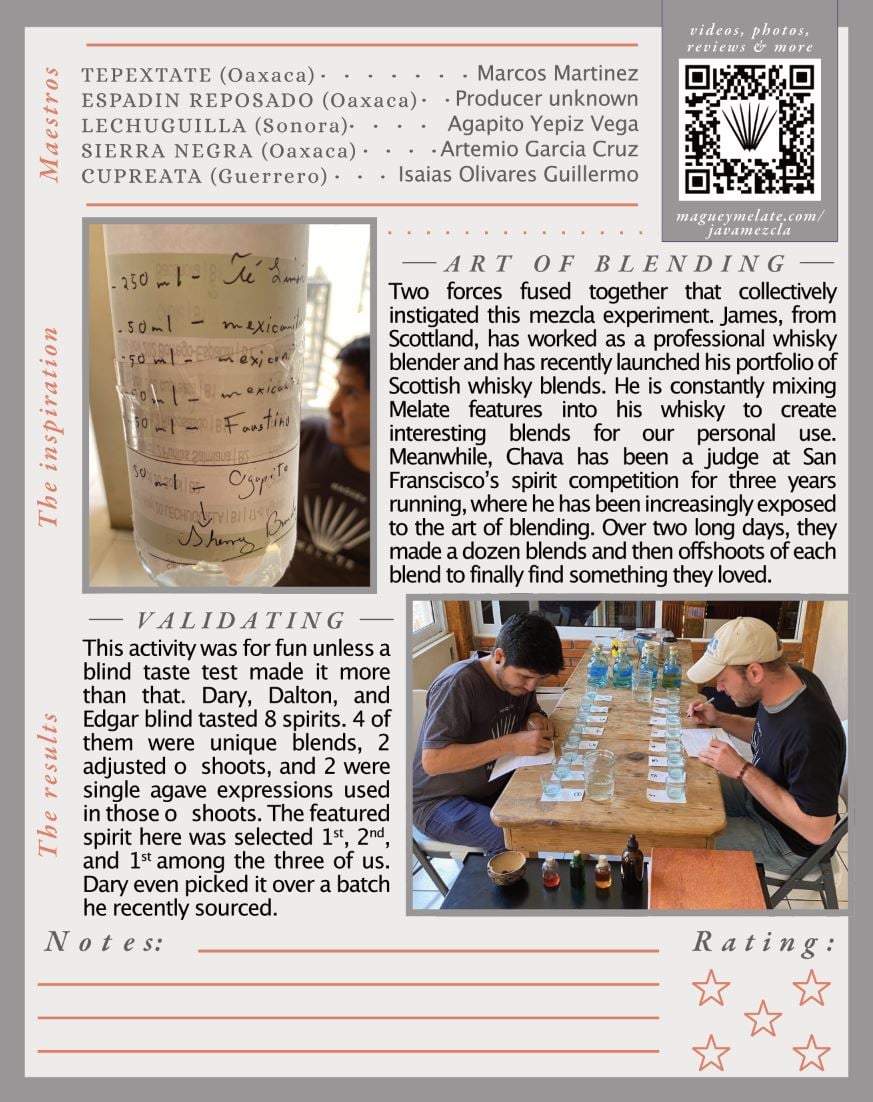
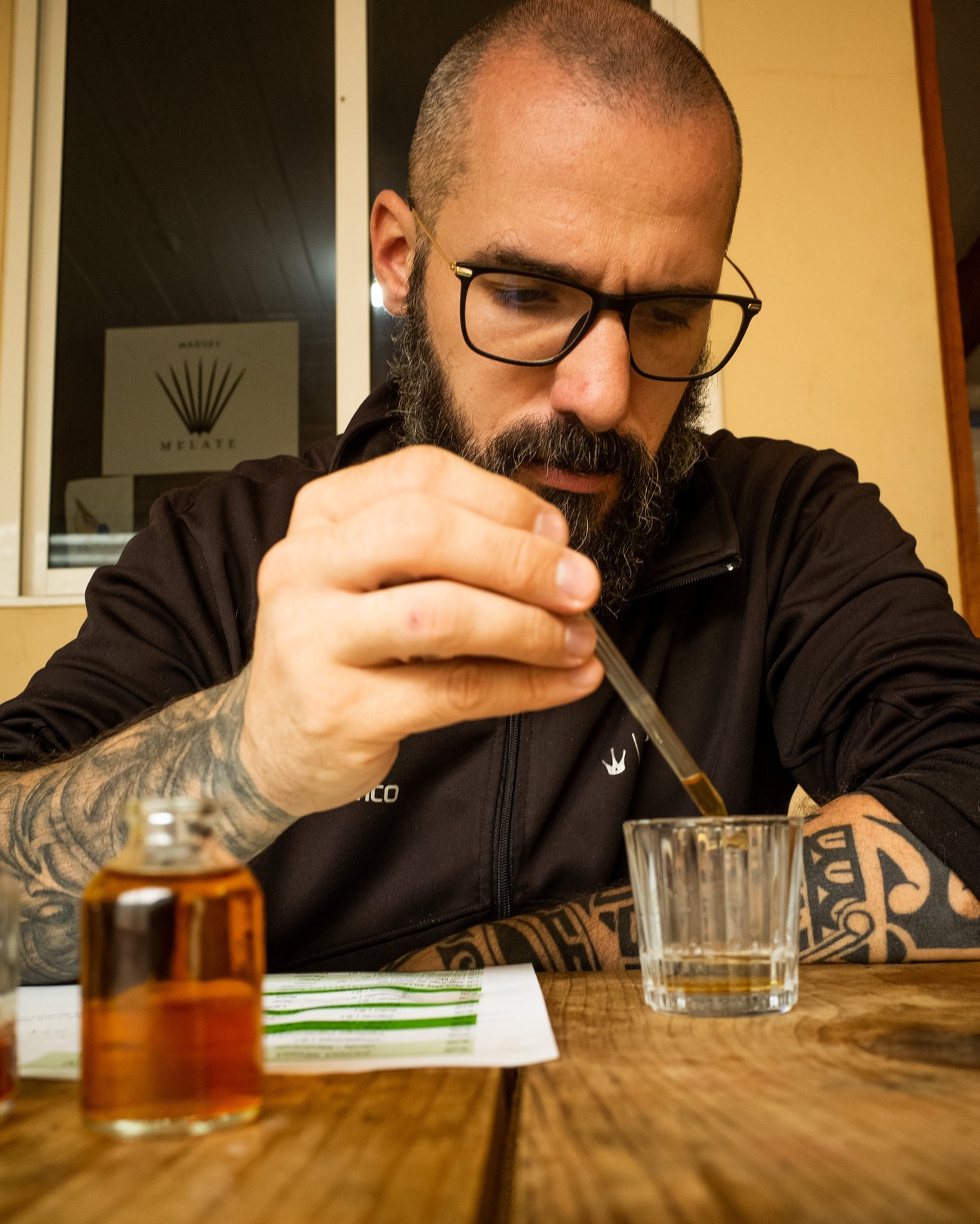
As you can imagine I kept dreaming about the possibilities of translating these experiences into mezcal. However, I couldn’t find someone in Mexico with the experience to guide and structure such an experiment. After much thinking about this, one fortunate day, joven Dalton introduced me to Jim. He is a scotch and whiskey expert who has a knack for blending. We sat for a whole afternoon at Dalton’s flat and after nerding for a while and sipping some of his creations I knew right away that he would be the perfect person to bring into a project like this.
So we jumped in Dalton’s faulty van (it got scary at times), drove to Oaxaca, and spent two full days at the Maguey Melate headquarters. Mixing and sipping; bouncing ideas, dealing with frustration, finding little rays of hope, and starting all over again. After the first day, we were almost sure that this was an impossible task. We kept on failing to achieve a coherent well-rounded spirit.
But then, at some point on the second day, we had a first eureka moment, and then a second, and even a third one. After much suffering at last we had three blends he could get behind. Finally, we had achieved flavors and aromas that felt balanced and exciting. Blends that honored every one of the spirits that were part of the puzzle but that held a unique fingerprint.
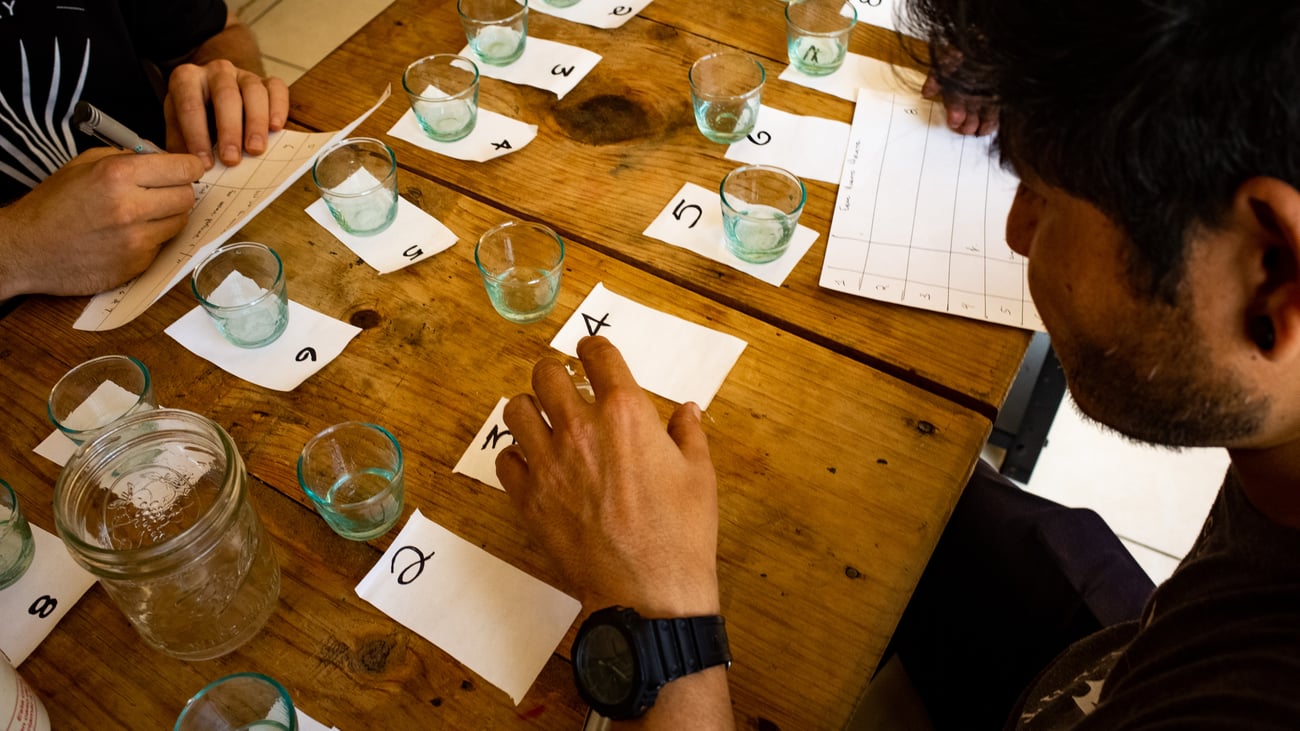
To quality-check the final products we made a few blind tasting rounds taking advantage of the whole Melate team. The tasting lineup included many traditional mezcales mixed with the three blends. If York, Darinel and Dalton, who were our super tasters, had preferred the traditional expressions over our blends, the experiment would have been a failure. This would have been nothing but a rather expensive educational experience. Happily, the three mezcal purists ranked our blends over the “single distillery” expressions. And with such proof of concept, it was decided, right there and then, that the best-ranked blend was worthy of the Maguey Melate club.
In a nutshell that is the full story of how this feature came to be. We hope that you find some joy in the flavors we put together and we would love to get as much feedback as possible ( our team loves to read your tasting notes in Mezcal Reviews). In Maguey Melate we take great pride in exploring the limits of what is possible within the extensive multiverse of Mexican spirits. There is still plenty to do because we are certain of a bright future for this category and are thrilled to be part of it.
Enjoy your spirits and share them with those you love.
Want to know more about how we came up with this mezcla (blend)?
Follow along throughout the month on facebook or instagram to get all the videos, fun facts, and conversations about this month’s feature. Some topics to look forward to include:
- The individual expressions we used in the mix. Each one is connected to producers that we have featured in the past.
- The methodology and criteria we used to achieve a flavor profile that we loved.
- Conclusions about the potential behind this approach and how we see the future of mezcal experimentation.
Quotes of the Month
“When you care so much about something, you must be afraid. And that fear will drive you to find the best possible result. “
~ Jim

CRAFTSMANSHIP TRADITION SUSTAINABILITY


